Commonuity Contribution #2 Digital profile and Visitors and Residents Mapping Exercise
I think this weeks’s activities were particularly “eye opening” for me. Like some of my classmates, I wasn’t expecting to find much because of what I perceived to be generally limited presence online and private profiles. However, my results were surprising especially when it comes to the reality of my digital presence and how much databases might actually associate with you. Most of what I was able to find was generally associated with my academic and career work.
To start of this post, I thought it would be best to share what came up on internet instantly after pressing enter to search my name. The is following an image of what the only suggestion Google AI came up with instantly when I searched my name as “Anam Waqas”.

To be honest this may seem very insignificant, but to me it is very significant. The point is that my middle name is Asiya. However, I have never given this name as a part of any of my profiles that I created. Most of my profile, including prezi are made with my first name Anam although I might throw in my middle name occasionally while posting something.
Takeaway: What this means for me (or anybody)
Having done this, I found that many of my classmates were thinking about privacy and security. While they are completely right to be thinking this way, I found myself to be an odd one out. My mind shifted away from privacy and security and shifted more towards how a digital identity can develop beyond what you intentionally create. The fact that Google AI connected my name with “Asiya” made me realize that my online identity is not necessarily limited to the information I that I put in my profiles. Hartzog (2014) explains that search engines do more than simply store information and can influence how easily information can be discovered and how different pieces of information become connected. In my case, the connection between “Anam Waqas” and “Asiya” was not something I consciously created for my online identity. However, it appeared immediately in the results. This makes me question how much of our digital identity is actually something we construct ourselves and how much isn’t
Additionally, I have mainly used media for academics and career. So it was not surprising that the results were primarily connected to my academic and professional identity. The Prezi presentation, for example, represents something I created for an academic purpose. However, because it was the immediate suggestion after searching my name, what comes to my mind now is that it has now become part of what can be associated with my name online. This shows how even individual assignments and projects can contribute to a larger digital presence over time. And this connects to Eggers (2026) discussion on how digital technologies increasingly mix up the boundaries between an individual and their digital representation especially when it comes to voice, image, and identity. Although my experience is very different from Eggers (2026) examples, the broader idea of how digital representations can become separate from the intentions behind them is applicable to anyone social media platforms.
Personal insights
Below is my V & R map. The coloring doesn’t have much significance except that I wanted to make sure that my map was visible. Another thing to point out is that I may have used many other platforms in the past, but I have only mapped out the resources that I are currently in use (over last 3 years).
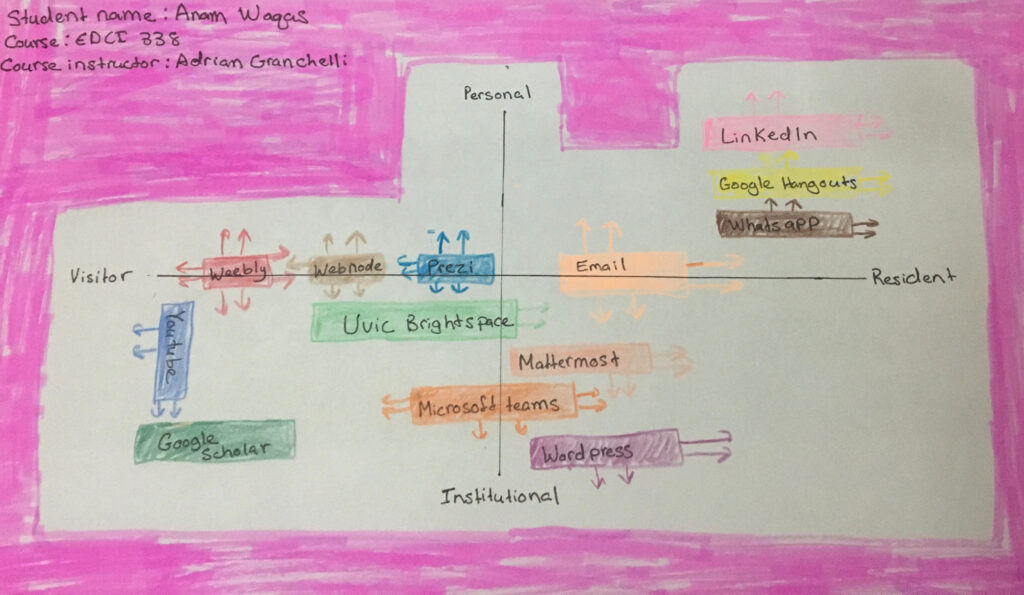
Looking back at my digital footprint alongside my Visitors and Residents map, I can see how the two activities (community contribtution #2 and V&R map) are connected They both show that my online presence depends largely on how and why I use digital spaces. White and Le Cornu (2017) explain that the Visitors and Residents map acts as a continuum rather than a way of categorizing people. Consequently ndividuals may move between different modes depending on the context and purpose of their online activity. This resonates, in my opinion, to my map because I identified many of my endeavors that were first classified as academic interaction, to shift also into a residential and even personal interaction as well. This recognition is represented by the arrows which indicate the constant “shift” that can occur depending on how we interact with these data bases. For example my intial use of prezi was solely for institutional purposes but has slowly shifted toward representing myself at a personal level.
So what did I learn about myself in this activity? I learned that I may not have a large social-media presence, but I do constantly sgift between visitor and residency when I interact with online spaces.. As White and Le Cornu (2017) note, mapping digital practices can make these patterns more visible and encourage individuals to reflect on how they engage with the Web. For me, this means that that my digital identity is not simply based on how much I use the internet, but on the different roles and purposes I have when I enter different digital spaces.
References:
Hartzog, W. (2024, January 20). Google can’t forget you, but it should make you hard to find. Stanford CIS. https://cyberlaw.stanford.edu/publications/google-cant-forget-you-it-should-make-you-hard-find/
Eggers, A. (2026, March 26). Copyrighting Voice and Image. Verfassungsblog. https://verfassungsblog.de/copyrighting-voice-and-image/
View of Using ‘Visitors and Residents’ to visualise digital practices | First Monday. (n.d.). Firstmonday.Org. Retrieved October 2, 2026, from https://firstmonday.org/ojs/index.php/fm/article/view/7802/6515